The horizon is not so far as we can see, but as far as we can imagine

Tag: Ukraine War Page 1 of 7

Facts On the Ground In Ukraine

Escalating against a more powerful foe is usually a bad idea.

Ukrainians are finding this out now. There’s no denying that Ukraine’s strikes on Russia oil infrastructure, especially refineries have been effective, or that its strikes against Russian shipping had an effect but that campaign led to Russia changing its strategy as well.

It has basically turned Ukraine into a landlocked country with massive strikes against Ukrainian ports. This is as the harvest needs to be sold.

A systematic attack on gas and diesel distribution in the country, by taking out gas stations, has made logistics within the country extremely difficult. It’s not just that Ukraine is landlocked, it’s that once you get into the country by land, it’s hard to move at all.

This has always been the problem Ukraine faces: Russia is just more powerful. Putin was very restrained for most of the war, not taking out dual use infrastructure, letting power stay on, etc, etc… This is the sort of stuff that the US usually takes out first, as it did in both Iraq wars. Russia didn’t.

But while Putin has been remarkably humane for a wartime leader, there is an implicit quid-pro-quo here: we leave certain things alone and you return the favor. Ukraine, knowing it was slowly losing by accepting that status quo has broken it multiple times and each time Putin’s release of constraints on the Russian military has meant that Ukraine was hurt worse than Russia.

It’s instructive to notice that in the Iranian war the US has actually been fairly restrained compared to its normal operations, for the simple reason that while Iran can’t hit the US homeland, it can hit US allies infrastructure. So Trump’s latest promise to turn off all the lights in Tehran came to nought, as have the past threats, because Iran can turn off the lights and water in the Middle East, and more importantly, smash oil production and refining in ways that would take a decade to repair, even as US petroleum reserves keep dropping.

John Arnold put together a good timeline:

March 23: Postponed announced attacks on Iran’s power grid, citing “very good and productive” negotiations March 26: Extended deadline by another 10 days; negotiations were “going very well.”

April 7: Two week ceasefire to give time to conclude a proposed 10-point plan April 21: Extended ceasefire indefinitely after mediators requested more time May 18: Held off a major strike because “serious negotiations” were underway

June 11: Canceled strikes hours after threatening to hit Iran “very hard,” claiming a negotiating breakthrough

June 17: Signed an interim ceasefire agreement ending hostilities and beginning a 60-day period to negotiate a final agreement

July 27: Paused bombing campaign to give diplomacy another chance

August 1: Canceled planned attack after claiming that Iran had agreed on parameters of a deal

Iran says there’s not only no deal, but they aren’t even talking.

So deterrence has, to some extent, worked in the Middle East, but it hasn’t worked in Ukraine.

Zelensky is now offering Russia an “air campaign” cease fire: they’ll stop hitting Russia’s oil infrastructure and ports in exchange for the same.

Too late is my guess. “Now that this strategy is hurting us more than you, let’s stop” isn’t likely to be all that convincing to Russia.

Ukrainians are resisting conscription massively, the Russian army’s advance is slow, but it continues to advance, and Ukraine’s almost out of interceptors, since they’re going to the Middle East and Israel. A promise to let Ukraine make its own patriot missiles is unlikely to work: if they build them in Ukraine, they can be hit. This isn’t like drone manufacture, you can’t farm it out to thousands of dispersed households: it’s need a real factory, and the Russians will find that factory and hit it. Oh, and Ukraine’s post-war population is likely to be ten million less than the pre-war population, with women massively outnumbering men.

Ukraine needs a comprehensive peace deal. Much like America in the Middle East, this is a war it cannot win and which hurts it more than it hurts Russia. When you can’t win a war, you make concessions and go to peace. Denial of reality is not a war plan, it’s a way of marching to doom. At some point the Ukrainian army will collapse, and the conditions that Russia imposes in an unconditional surrender scenario are a lot worse than those they’ll get, even now, in a negotiated peace.

The same is true in the Middle East. Yes, Iran can’t conquer America, but what happens when diesel and gasoline and fertilizer and plastic and medicine shortages all hit the US mainland? The deal America gets in that situation is worse than the deal it gets if it makes peace now.

When you’ve lost a war, you’ve lost the war. Making your opponent prove it across the board will never lead to a better outcome.


What I write here is for the benefit of everyone, but alas, I live in capitalism and I, and the site, take money to keep running. If you value the writing here and can, please subscribe or donate.
Another Decent Summary Of The Ukraine War

I’d have just linked and excerpted, but this account is currently private. My comments in italics.

It’s immediately apparent when someone has zero exposure to Ukrainian language reporting on the war, which is the norm. There’s an entire parallel infospace where actual AFU soldiers and even the mainstream Ukrainian media speak quite frankly about the war in a way that would shock most casual observers. So what are the Ukrainians saying about the current strategic balance?

• Ukrainian residents of large cities need to evacuate them because major cities will be unlivable this winter (former Minister of Defense Dmytro Kuleba) Civilian infrastructure was not significantly targeted by Russia till Ukraine started hitting Russian energy infrastructure. Escalation does not favor the weaker side.

• Ukraine has no Patriot interceptors left and all Ukrainian infrastructure will be destroyed unless something changes (MoD aide Serhiy Bezkrestnov) This is credible because the interceptors have been going to Israel and US forces in the Middle East by priority, so much so that we had reports of missiles being transferred from the Pacific. It also explains why the US is talking about letting Ukraine manufacture its own patriot missiles.

• Russia’s deployment of jet-powered Gerans is increasing while 200 older gas powered Gerans attack Ukraine every day (Sergei Bezkrestnov, MoD)

• Russian EW and air defense are becoming more advanced and are being deployed more widely, mitigating the effects of the Ukrainian mid-range drone campaign, while Russian drones are increasingly equipped with AI image recognition terminal guidance. Ukrainian EW and AD aren’t keeping up (Oleksandr Karpyuk, AFU) This is the opposite of what is being reported elsewhere. I don’t know the truth of it, but Russia does have industrial power and Chinese backing.

• The Russians retain the initiative essentially everywhere on the front line (Ukrainska Pravda) Fits with what I read from other alternative sources.

• The mid-range drone campaign has had zero effect on the situation on the front line (Ukrainska Pravda)

• The triumphalism in the Western press is exaggerated and premature. The most realistic Ukrainian goal now is simply to stop the continuous degradation of the AFU’s position, which has been underway since 2023 (Ukrainska Pravda)

• The Russian campaign against Ukrainian fuel infrastructure, gas stations, and power plants will result in a “Crimean situation” across much of Ukraine unless drastic measures are taken (Dmitry Leushkin) Again, Ukraine escalated and Russia matched the escalation, but has more capacity.

Reading Ukrainian reporting, the mid-range drone campaign is turned on its head. Ukrainian planners hope to manufacture 100,000 mid-range drones by the end of the year not in the expectation that it’ll fundamentally shift the balance in their favor, but to help close the gap with the years-long Russian glide-bomb campaign. This target is extremely ambitious, but if achieved, it would put them roughly at parity with the number of glide bombs Russia drops on Ukraine in a year.

The issue is that none of these drones have anything approaching the payload of a Russian glide bomb, with drones like the Hornet delivering something like 4.5kg of explosive to a FAB-250’s 100kg. Drones are more versatile, but the Ukrainians have a long way to go to catch up. In most ways, the drone war is a game of leapfrog, but the Ukrainians still have major disadvantages that have strong effects on the frontline. All the information above was shamelessly cribbed from @EventsUkraine, who tirelessly compiles reports from the Ukrainian media and Telegram multiple times a week. Reading his Substack will expose you to a side of the war that’s rarely visible in the Western press.

This seems more aligned with what I’d expect. He notes elsewhere that he thinks that Ukraine can keep up manpower losses for another few years. I’m not sure, nations tend to collapse before the very end of their manpower.

Basically, a war of attrition favors the side with more weapons, more advanced weapons and more manpower. Which is what I noted at the very start of the war. Ukraine has done amazingly well, far better than most expected, in large part due to massive NATO support, which Trump has recently doubled down on: he seems to have given up on peace.

It should also be noted that the increased attacks in Russia, which are made with Western supplied weapons, whose targeting is chosen by Westerners, and which are overseen by Westerners are degrading Putin’s ability resist hardliners calls for direct strikes against European sites. This war could easily escalate especially if Ukraine makes a high symbolic value attack that hits a major cultural site or kills a lot of civilians.

In “turn about is fair play” Russia appears to have been helping Iran with satellite data and targeting, which is exactly the sort of blowback many of us warned about.

Empires die messy. America’s is dying, and a lot of people are dying with it. Let’s hope this doesn’t turn into a world war at some point, as it did twice during Britain’s decline.


What I write here is for the benefit of everyone, but alas, I live in capitalism and I, and the site, take money to keep running. If you value the writing here and can, please subscribe or donate.
Russia War Situation & A Possible EU/Russia War

This is elevated from comments, by Purple Library Guy.

Picked up and posted on the front page because it’s a balanced assessment. No, Russia isn’t losing, and it’s interesting that so much Western media is suggesting it is. That said, Russia isn’t having everything its way either. – Ian

As to the current war, Russia is winning, but I’d have to say I don’t think they’re real happy with how it’s going. The damage Ukraine is doing to Russia is real, the damage they’re doing to Russian logistics in Crimea is serious and could lead to a Ukrainian offensive with some success in that area. They have had some success in counterattacks in Zaporozhia. Drones have allowed them to hang tough on the defensive for far longer than they could have without that huge technological shift on the battlefield. It is not going all Russia’s way, or how the Russian high command would prefer it to be going. They’d really prefer all that stuff wasn’t happening.

But that said, Russia has nonetheless done FAR more damage to Ukraine and the Ukrainian armed forces than Ukraine has done to them. At the moment, Ukraine and Russia are attacking each other with similar amounts of long-distance drones, but Russia has much better defenses so does not get actually hit with as many. Still more than they’d like, but not as many. But on top of that, Russia is still doing damage with bombs dropped from planes, missiles, and even some old fashioned artillery. Ukraine doesn’t have much of any of that. They do have some missiles, mostly from the Brits, but not in comparable numbers. Where Russia has lost serious logistics capability in one place on the front, Ukraine’s logistics and military capabilities and manufacturing have been seriously eroded over the whole country.

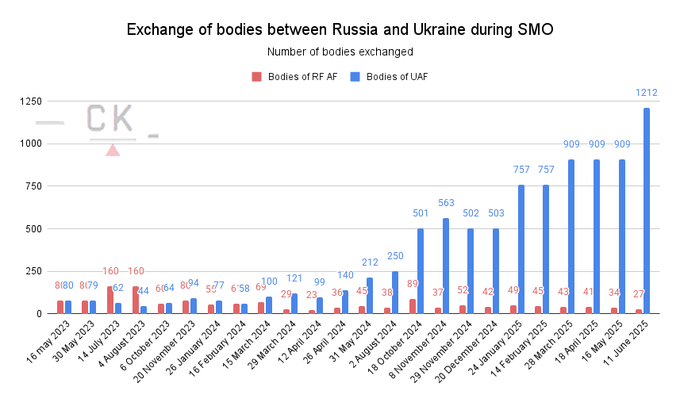
And the attrition at the military level continues at a solid pace. Some hackers claim to have gotten hold of Ukrainian casualty numbers; apparently 2.4 million Ukrainian troops dead or missing, 400,000 of which are from so far this year. I don’t think Ukraine is replacing troops at a rate of 400,000 per half-year. Already I hear some sections of the front are held almost entirely by a few drone squads. At some point men, materiel and/or logistics erode to the point where sections of the front just can’t be held. Probably if they mount a serious counterattack around Crimea, that just accelerates the time when that happens, even if the counterattack is tactically successful.

As to a possible more direct war between Europe and Russia . . . I think they would find themselves dealing with the same problem Russia has, only much worse. Drones favour the defense massively at the level of taking territory. In such a war, Russia would be on the defensive, and Europe would be getting creamed by drones as they tried to advance. The difference being that Russia is fundamentally much stronger than Ukraine, and so the drone revolution on the battlefield can drastically slow the Russian win but cannot in the end stop it. Whereas Europe is not fundamentally much stronger than Russia in military matters, and so trying to take the offensive against a Russia with, now, much more experience in drone warfare than Europe, would lead to European armies being fed into a meat-grinder. And I don’t think Europe has the stones or the unity to keep up an aggressive war of attrition for all that long once the casualties start mounting up.

This is a very good thing, because if Europe attacked Russia and Russia felt really threatened, there would be a nuclear war and we would all die. It really creeps me out that hardly anyone seems to notice this problem any more.

The Middle East Is Hastening Ukraine’s Fall & The End of the European Era

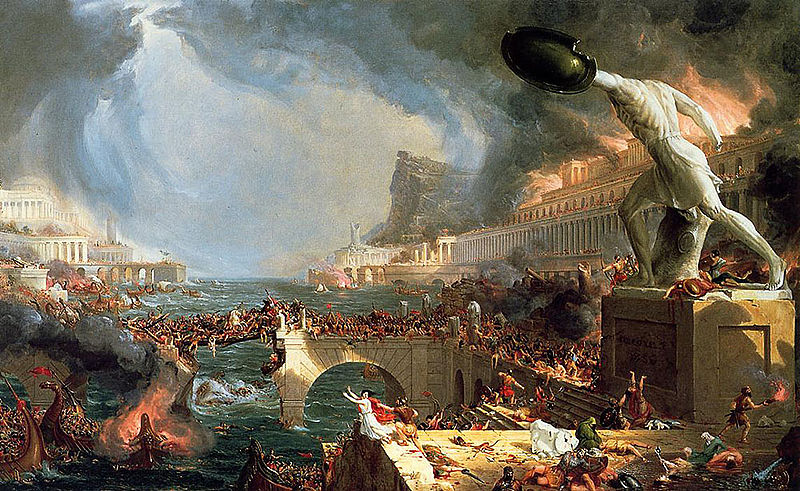
The Course of Empire by Thomas Cole

The Course of Empire by Thomas Cole

Rarely spoken of is the effects of the Middle Eastern wars on Ukraine. For a long time, Ukraine got everything it wanted, but since Oct 7th, it has been , or worse, on America’s priority list. Mossad has a great deal of influence in America, just short of control, almost certainly due to a sickening collection of videos and pictures, and Israel has received the first cut off everything it needed: most especially of interceptor missiles.

Even so, the reason that Israel and the US called for a ceasefire and Iran did not (though it accepted one) is that Israel was less than a week from running out of air defense missiles, and as best I can tell, the US could only have supplied about another 7-10 days worth.

What this means for Ukraine is simple enough, they’re being absolutely hammered by Russian missiles and bombs. They don’t have enough air defense, they don’t have enough missiles for the air defense, and there is no reasonable prospect of re-stocking. The West’s larder is empty.

The tempo of Russia advances continues to increase. It’s still slow, but it’s at least eight times as fast as it was a year ago, and as Ukraine runs out of men, weapons and ammunition (Western shortages go far beyond air defense), plus as morale continues to plummet in Ukrainian armed forces, the prospect of “big arrow” warfare grows closer.

As I’ve said before I expect that period will arrive next year. The fighting age male population is decimated, those willing to fight are or will be mostly dead, and Russia will win the war decisively, taking whatever they want to. The only danger of this not happening is Putin accepting a peace offer before that: like Khameini, he is very cautious, doesn’t like war and wants it over. If Zelensky ever gets his head on straight, or is replaced, he’s likely to accept a peace deal much short of what can be accomplished by arms and an unconditional surrender.

This will be a HUGE loss for the West. The first war they have decisively lost on the battlefield in generations. There will be no concealing it, and the inability to ramp up production of weapon systems and munitions will leave the collective West so weak that no one will be able to believe they could win a conventional war against China, or even Russia.

It will, psychologically, be the end of Western hegemony. For almost 400 years the West has been dominant, and since Industrial Revolution, overwhelmingly dominant.

That era is almost over. The economic aftershocks will be huge: the end of American dollar hegemony is likely within five years, ten at the most and the entire world except, perhaps, Canada, the US and Europe, will re-orient to China. The US will even lose South Korea and Japan as reliable allies, indeed, it arguably already has (more on that another time.)

This is a literal epochal period. The “nothing ever happens” fools are missing that this is the end of a literal era: the era of European supremacy (the US is just a European settler state and Britain’s successor.)

The new era will be multipolar only if China wants it to be. They are approaching “America after WWII” levels of industrial and technological power. However, for at time, they will probably allow a multipolar world, as they are smart enough not to want to be a superpower or “world cop.”

Normally this would cycle to a superpower period, but environmental issues are likely to short-circuit normal macro-geopolitical cycles. Everyone will wind up in survival mode, and the question will be who manages this best. Whoever does will lead the next cycle, which will occur long after most or all of us are dead.

So, as best you can, you may as well be interested. You are living in truly interesting times, which come around only every half millenia or so.

If you’ve read this far, and you read a lot of my articles, you might wish to donate or subscribe. I’ve written over 3,500 posts, and the site, and Ian, take money to run.

Ukrainian War End Prediction

When the war started, I predicted that Russia would win militarily. That was an easy, obvious prediction based on the fact that Russia is larger, has more industry, and that China would not allow sanctions to take out Russia, knowing it would be next, but would keep the Russian economy running.

This prediction is a little more risky because the war could end due to a peace deal. There’s no question that Ukraine is losing, and that the battlefield is getting worse and worse for them.

Russian forces are back within 300 kilometers of Kiev. While advances are slow, they are speeding up. The Ukrainians are running out of manpower, are considering mobilizing women for infantry, and have huge problems with desertion and recruitment. Russia has ramped up weapon production far more than the West.

So I’m going to keep this one simple: The war will end next year with the Ukrainian army collapsing. Ukraine will be forced into an unconditional surrender, and Russia will take what it wants.

There’s lots of ways this could go wrong. The Euros could rush in “peacekeeping forces.” Putin could agree to peace before then. The “Ukrainians” could provoke Russia into using tac nukes with their strikes of strategic nuclear infrastructure. Putin might die, and if he does he’ll be replaced by someone far more aggressive. So this isn’t a “sure thing” prediction, just a best guess.

But basically, that guess is that the Ukrainian army collapses next year, and we see huge “big arrow” movement.

Putin is likely to remember the lessons of Syria’s frozen conflict, and of Russia and Ukraine’s fake peace of 2014/2015. No frozen conflicts, no fanatical enemies still able to fight. Russia has paid dearly to crush Ukraine, and it would be foolish to throw away what is being won on the battlefield at a fake peace conference with Europeans and Americans who have no intention of keeping any deal.

So, most likely, he will win the war and impose the peace. If he’s really smart, he’ll take Odessa and turn Ukraine into a landlocked state, even if that means some extra casualties and time.

Russia was always going to win the war. The questions are simply when, by how much, and what Ukraine is left with afterwards.

***

If you’ve read this far, and you read a lot of my articles, you might wish to donate or subscribe. I’ve written over 3,500 posts, and the site, and Ian, take money to run.


Western Leaders Continue To Live In A Delusional LaLa Land With Respect To The Ukraine War

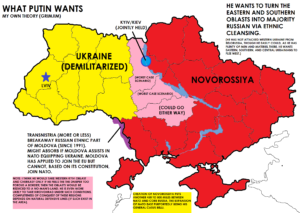
Putin's Goals by GrimJim

Putin’s goals by GrimJim

So, the Europeans have said that Russia must grant an unconditional 30 day ceasefire, or they’ll ramp up aid to Ukraine and put on more sanctions, including some against Nord Stream II. They claim Trump is onside, but Trump hasn’t confirmed this.

The Russians have indicated willingness for a thirty day ceasefire, but they have a condition: for those thirty days, weapon shipments from the West to Ukraine must stop and Putin has straight up rejected the unconditional ceasefire.

What a surprise.

What Europeans want is for Russia, which is winning on the ground, to give them thirty days to rearm Ukraine. Can’t imagine why Russia won’t go for that.

The Euros are delusional. They have no leverage. They’ve already said they intend to end all energy purchases from Russia as soon as they can. (That isn’t yet, they’re buying tons of Russian energy still, it just goes thru India first.)

Why the hell would Russia agree to give Ukraine time to re-arm and entrench without something in return.

Once again, Russia’s best alternative to a negotiated agreement is to simply win the war. And while advances are still slow, they’re all on Russia’s side and the Ukrainian army is showing signs of being near the breaking point. They’ve also been pushed past almost all of their prepared defenses.

Personally, I think Putin is being incredibly generous offering a ceasefire at all. I think that’s a mistake.

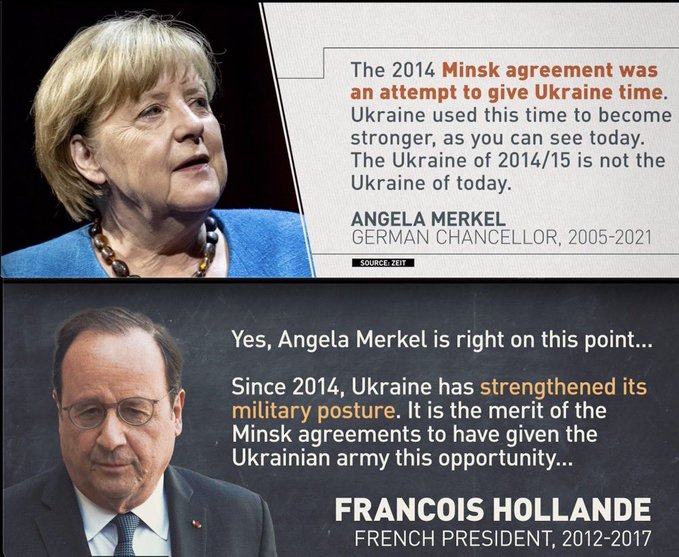
But the Euros are living in LalaLand. They don’t have any real leverage and they keep acting like they do. Ukraine is losing. Nothing the US and Europe can do, short of declaring war, will change that fact. And since the Euros have admitted the Minsk accord were signed with the intention of building up the Ukrainian army for another war, well, why the hell would Putin want to make a new deal that creates another frozen conflict?

Just insane. Europe doesn’t get that they are a has-been power, in serious decline and that they just can’t push other nations around any more. They don’t have the muscle or the industrial base or the tech lead any more.

The war will be ended on Russia’s terms unless Putin is incredibly foolish. That’s possible, contrary to the Western narrative Putin isn’t a Hawk, he’s the least Hawkish person anywhere near power in Russia. If he was to have a heart attack tomorrow, whoever replaced him would be far more militaristic and far less restrained. Putin prefers peace. He’s just learned, probably, that peace can’t be made with the West, it must be imposed.

This blog has always been free to read, but it isn’t free to produce. If you’d like to support my writing, I’d appreciate it. You can donate or subscribe by clicking on this link.

Understanding America’s Betrayal Of Ukraine

Let’s start with this: Ukraine is losing the war, and the longer it goes on the worse the peace deal will be. I absolutely agree with Trump that there needs to be a peace deal, and soon.

But the rhetoric coming out of the Trump administration and its proxies suggests that America owes Ukraine nothing, and that indeed, Ukraine owes America for all its support. This sounds reasonable, on the face of it, but only if you don’t know any history.

Let’s start with the 2014 Maidan protests which overthrew the Ukrainian government. They were a color revolution, heavily supported by the Americans and Europeans. Say what you will about Yanukovych, he was the elected President. There’s decent evidence that the sniper massacre was done by Maidan itself (see this academic study), and, post-coup, Ukraine was essentially run by Victoria Nuland.

The Maidan coup came in response to Yanukovych’s decision to accept Russia’s aid package instead of the West’s. This was the correct decision: Russia offered more money and aid with less strings, while the Western aid came with IMF restructuring. If you know anything about the IMF you know that their restructuring is always painful, and it doesn’t improve host nations economies. It does, however, increase inequality, and opens up the economy so foreigners can buy in.

Back in 2008 there was a brief Georgian/Russian war. Georgia had regions which were ethnically Russian, and they were de-facto independent, and recognized as such by Russia. When Georgia invaded South Ossetia, Russia counter-invaded. At the time, I wrote an article for FireDogLake predicting the next Russian war would be over Crimea and Sevastopol. Sevastopol is Russia’s main Black Sea port, and a Russian “hero city,” — much beloved. Ukraine leased it to Russia, and if Ukraine ever moved to kick the Russians out I predicted the Russians would go to war rather than comply.

Put simply, Sevastopol was and is a key Russia interest.

After the coup, Ukraine threatened to end the Russian lease. Russia invaded Crimea, and took it over. (Don’t cry too much, most Crimeans, except the Tatars, would much rather be Russian). Meanwhile, the East of Ukraine went into revolt, because they are mostly, actually Russian and had supported the ousted President. A small war was fought over that. The Russians intervened, routed the Ukrainians, and they set up a peace deal called the Minsk accord, which basically gave Donetsk and Luhansk semi-autonomy.

Notice that without the coup, which was backed by the US, there would have been no 2014 war between Ukraine and Russia, no loss of Crimea, or and no semi-independence for the far East of Ukraine.

The coup was anti-democratic, overthrowing a legitimately elected government which was accepting the best deal offered. (And folks, I’ve studied IMF deals. They are always bad. Always.)

Of course, having lost a war and territory, Ukraine now becomes very anti-Russia, at least in the West of the country. Understandable. Then there’s a HUGE military buildup. And, although Minsk was sold as the end of the matter, it was negotiated in bad faith by the West. This has been confirmed:

The West didn’t want peace, it wanted a chance to build up the Ukrainian military for the next round.

That next round came after Ukraine spent a lot of time shelling the hell out of Luhansk and Donetsk; this was a violation of the Minsk agreement. Then Ukraine and NATO started talking about Ukraine joining NATO, which Russia had made clear was a red line.

Now here’s the thing: Absent the US backed Maidan coup, there would be no Ukrainian war. It wouldn’t have happened. Additionally, absent the huge build up of the Ukranian military, again US- and EU-backed, there would have been no war, because Ukraine wouldn’t have risked it.

The US used Ukraine in a proxy war, after an anti-democratic coup. The West genuinely believed that sanctions would break Russia and allow Ukraine to win the war, and hoped that the loss would cause a break-up of Russia. Unfortunately for them, China needed Russia as an ally, and kept the Russian economy running, and it is Europe that was damaged by the sanctions, while Russia’s economy is, overall, booming.

Back near the start of the war, a peace offer was on the table, far more generous than anything Ukraine can expect now. Boris Johnson, Britain’s Prime Minister, with US support, told Zelensky not to take it — NATO would back him to the hilt, and Zelensky could win the war.

Fast forward: Ukraine is losing the war. On a map, Russian gains over the last year aren’t all that large, but the Ukrainian army is running out of manpower, and is being pushed past its line of prepared defenses. When the Ukrainian army breaks, and it will, the Russians will start making huge advances very quickly.

Now, Trump comes in, and acts as if America had nothing to do with all this and, further, acts like Ukraine has taken advantage of American generosity instead of Ukraine being an American proxy, which has been devastated after an American coup pushed it into a war with a much stronger country and America and the UK told Ukraine not to take a better peace deal.

Trump’s attempting to get Ukrainian minerals in “repayment” for America pushing Ukraine into a war it couldn’t win, and is not even offering security guarantees in exchange. I loathe Zelensky, but he’s right to reject this one-sided “deal.”

This is despicable. This is honorless. The very least Ukraine deserves from America is a sincere effort to cut, for Ukraine, the best peace deal they can get.

Now Zelensky is delusional. Threats to fight on and a refusal to negotiate are insane. Russia’s BATNA (best alternative to a negotiated agreement) is to just continue the war, win it, and impose an unconditional surrender. Think Japan and Germany at the end of World War II.

But American negotiation seems to be about making the best deal for America, not for Ukraine.

My suggestion would be that Zelensky ask the Chinese to host negotiations. Yes, they’re Russia’s ally, BUT they’ve always supported a peace deal, and more importantly, they’re the only nation which really does have leverage over Russia; without China, Russia cannot survive economically. And, unlike America, China has said it is willing to put peacekeepers in Ukraine. Russia is NOT going to target Chinese troops.

Further, if China promises to rebuild Ukraine, it will do so, and do so quickly and competently. The Chinese are the best in the world at building roads, railways, ports, power plants, and all other types of infrastructure.

Ukraine’s government was effectively controlled by the West, and pushed into a war it couldn’t win. They need to end their Western alliance, and cut the best deal they can get. That means, especially, not letting Trump negotiate, because he’s not negotiating for them, but for America.

It’s a bad hand, an awful one. But it’s the hand Ukraine has to play.

As for American claims that Ukraine used them, rather the other way around, they are without merit and beyond dishonorable.

Let’s give Kissinger the final word:

“It may be dangerous to be America’s enemy, but to be America’s friend is fatal.”


You get what you pay for. This blog is free to read, but not to produce. If you enjoy the content, donate or subscribe.

Understanding the Russian-American Ukraine Peace Negotiations

Let’s take a look at these negotiations in more detail. First, a summary of Secretary of State Rubio’s:

  • Ending the conflict in Ukraine will require “difficult and intense diplomacy” over a long period of time.
  • Ending the conflict in Ukraine will require concessions from all sides and is only possible with their consent, the conditions must be “acceptable”
  • Trump wants to end the conflict in Ukraine fairly and not allow it to resume “in 2-3 years”
  • The EU must be at the negotiating table at some point, as it imposed sanctions against Russia
  • The future of the negotiation process on Ukraine will be determined by the willingness of the parties to “keep their promises”, this will be shown in the coming weeks
  • Ending the conflict in Ukraine will open the way for Russia and the US to cooperate in economics and geopolitics
  • There have been no significant US-Russia contacts for almost three years, the meeting in Riyadh laid the foundation for future interaction
  • Work to restore the activities of Russian and US diplomatic missions could be quite quick
  • Restoring the normal operation of the US and Russian diplomatic missions is the “next stage” of the negotiation process between the two countries, since the US considers it impossible to negotiate with Russia on Ukraine without the normal operation of diplomatic missions

This is all remarkably sensible, actually, and the idea that the two great powers with the most nuclear weapons did not have regular diplomatic contacts was always dangerous and stupid.

As discussed here before, the American intention is to make Europe provide peacekeepers and pay for reconstruction, and America hopes to force Ukraine to sign over a large amount of mineral rights, though Zelensky has, quite rightly, so far refused to do so.

Meanwhile, there’s this piece of wishful thinking:

The United States is trying to “break up” Russia’s alliances with Iran, China, and North Korea. This was announced by Keith Kellogg, the US President’s special representative for Ukraine, during a conference in Munich, CNN reports.

Some commenters think that this is what America and Russia want — an end to the above alliances and:

What Putin wants: No NATO membership, (non-negotiable), 4 oblasts in Ukraine and Crimea, including territories not currently occupied by Russia

What Trump wants: Break ties with China (non-negotiable), join US sanctions on China

I’m reasonably certain ending the alliance with China and joining US sanctions on China is a non-starter, and if that’s non-negotiable, then there isn’t going to be a deal. China, North Korea, and Iran all helped Russia when Russia desperately needed help. It is no exaggeration to say that if China had not supported Russia’s economy, the anti-Russia sanctions would have worked, and Iran and North Korea provided weapons and munitions the Russians desperately needed while they were ramping up domestic production.

While simultaneously trying to cut this deal, Trump is turning on long-term allies, threatening them with sanctions — and in the case of Greenland/Denmark, even saying he refuses to rule out using military force. America’s record of keeping agreements is abysmal.

Over the decades of observing Putin, I’d say that he values reliability more than almost anything else. The Iranians, North Koreans, and Chinese are reliable. America is not.

In negotiations there’s a concept known as BATNA: your Best Alternative To A Negotiated Agreement.

Russia’s is simple enough: It’s winning the war. Unless America is literally willing to go to war with Russia, there’s nothing they can do to stop Russia from winning, and then impose a peace after a Ukrainian unconditional surrender.

What’s America going to do, impose more sanctions? The Russia economy has done better under Western sanctions than it did before the sanction regime. Send more military aid? Cupboards are damn near bare. The only viable threat America has is to hit deeper into Russia, and that’s a real threat, but since such weapons are aimed and fired by Western specialists, that risks war with Russia.

What can America offer as an ally that China can’t? Only a removal of sanctions. That would be valuable mostly if it meant repair of NordStream and renewal of gas to Europe, but America wants to keep Europe as a captive customer for U.S. LNG (which is twice as expensive).

It’s hard for me to see why Russia would agree to get rid of reliable allies, and turn on China in exchange for an agreement from America which Putin must regard as unreliable. Sure, he’d like a negotiated peace, and an end to the war, but Ukraine’s army looks close to collapse. When that happens, Russia will suddenly start taking huge swathes of Ukraine. And “No NATO” is entirely achievable in an unconditional surrender.

Plus, Europe’s politics are changing. Parties which oppose hostility to Russia are coming on strong, and Europe is furious at Trump’s actions, and the words of his proxies. Right now, Europe is still full-on in support of Ukraine, and generally supports an anti-Russian stance, but time is likely to break that unity of hatred.

It’s not that Trump is wrong to want to break up the Russia-China axis. Pushing Russia into China’s camp was one of the greatest unforced errors of post-Cold War diplomacy, and an error I’ve written about in the past. With Russia in China’s camp, anti-China sanctions cannot work, because Russia is a land-based supplier of the food, mineral, fuel which cannot be interdicted.

But the ship has sailed. You can’t undo almost 50 years of anti-Russia policy overnight, because the last 50 years have proved to Russia that America can’t be trusted to keep agreements and, overall, China is far more reliable.

Suppose Russia cooperates against China, and America does manage to take out China. Who do you think would be next? Who does Putin think would be next?

So if joining anti-China sanctions really is non-negotiable, then these talks will fail. My guess is that this negotiation point isn’t actually required or non-negotiable, and that Trump really wants this war over one way or the other. But if this requirement is non-negotiable, the war will continue.

Meanwhile, restoring proper diplomacy between Russia and America is a good thing. We’ll see what comes of it.


You get what you pay for. This blog is free to read, but not to produce. If you enjoy the content, donate or subscribe.


Page 1 of 7

Powered by WordPress & Theme by Anders Norén