The horizon is not so far as we can see, but as far as we can imagine

Tag: GDP

It Doesn’t Matter What Europe’s GDP Is

Well, mostly.

Krugman shared this chart, as part of an argument that it’s ridiculous for Europe to be scared of Russia:
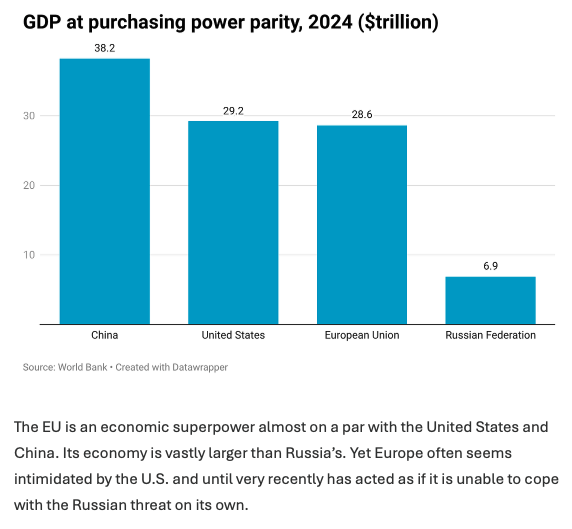
GDP indicates the value of the parts of the economy which are subject to money. (If you do something but don’t use money, it doesn’t get measured.) As such it theoretically measures how much you can mobilize using money. Back when most people lived off commons, before that was enclosed, and didn’t need to do much paid labor, you couldn’t mobilize much.

But that’s theoretical ability. It’s important, but what matters is what you do with it.

And the thing is that Russia does with it is build drones, advanced missiles, advanced jets and other weapon systems. And they build them in large amounts. Europe’s production of weapons is much smaller, and they’re less advanced than the Russian weapons. Russia also produces lots of oil and natural gas and has a huge refinery sector. They have a lot of rare minerals and resources in general. And they do still have both heavy and light industrial sectors.

Meanwhile Europe is hemorrhaging industrial jobs and its industrial energy costs are much higher than Russia’s.

So Europe may have more theoretical economic capacity, but it can’t translate that capacity into state capability where it matters. Russia is stronger than Europe.

It’s not that it necessarily has to be this way, but for Europe to match Russia it has to maintain and expand its industry, find cheap energy, and source natural resources that are scarce in Europe. It also needs a lower cost structure than it has in general terms.

These are not trivial problems. Europe is pushing on renewables, to be sure, but has some way to go and effectively has to buy those from China. It needs to get resources like oil and minerals from other countries and the closest and cheapest source of hydrocarbons, which it needs during the transition, is far more expensive than it otherwise would be. American oil and natural gas is FAR more expensive.

The other traditional source of resources was Africa: mostly ex-French colonial possessions. France never forgave their debts, had military bases all over and often forced them to sell resources at very low prices. But now that Africa doesn’t need European goods, they’re kicked the French out and raising prices and moving to do primary processing domestically.

So sources of cheap minerals are drying up.

All of this could be worked around, if Europe was a technological leader, but…
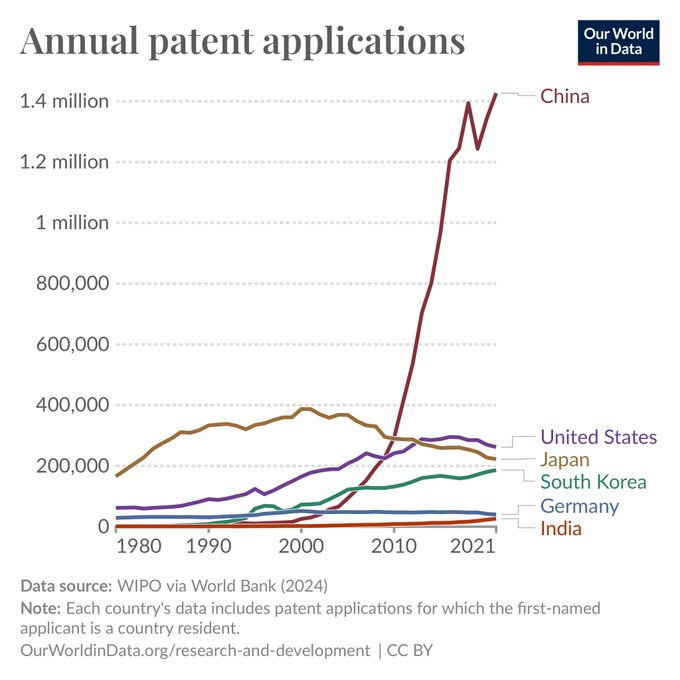
Now legacy industry matters. Machine tools. Steel. Chemicals. Stuff that Germany is good at. (Automobiles are dying, because yes, the future is EVs.) But Germany and Europe are losing those industries. And they aren’t producing the industries of the future. Everything they have is basically legacy industry, developed in the late 19th and 20th centuries. They aren’t creating, mostly, the industries of the 21st century.

GDP only matters if you can use the resources it suggests you have to produce what you need. When it comes to competing with Russia, Europe’s ability to do so is limited. Not non-existent, Germany has significantly increased artillery shell production, for instance, but not what it needs to be.

Without a colonial empire and without resource rich nations willing to trade Europe the resources it needs at reasonable prices, and without a tech lead, What does Europe have?

Very little.

And this is why Europe’s in for a long fall. There’s no easy route out and no one is even talking about doing what’s right. The center still thinks that the problem is that workers have pension and time off, the rising right are complete idiots who think the US is a good model and the left is not, in most cases, in contention. Germany’s AfD will not make Germany better off, it will continue destroying Germany. The same is true of UK’s Reform part and France’s right wing.

GDP is a stupid stat. It conceals more than it reveals. It doesn’t tell you much about the structure of a country. India, which in GDP terms is a great power just lost a minor war to Pakistan. High GDP can actually be bad, since it includes waste, billionaire income that does nothing for the country, and all the money earned in harmful industries like finance and private equity.

Europe’s high GDP isn’t meaningless, precisely, but it isn’t what matters. If it was, Ukraine would have won the war already and the EU wouldn’t constantly be on its knees groveling to America.

What matters is what an economy CAN do. And Europe’s economy can’t create what Europe needs.


Everyone reads these articles for free, but the site and Ian take money to run. If you value the writing here and can, please subscribe or donate.

The Chimerical Growth of GDP and Privatization

Modern economies are often measured in terms of Gross Domestic Product (GDP). Look up the definition of GDP and you’ll come up with something like this: a country’s GDP is the total value of all finished goods and services in a country in a year plus exports, minus imports.

Consider this, if a parent takes care of their children, is that included in GDP?

No, it isn’t.

What if the children are taken care of by a nanny or day care worker?

Then yes, it is part of GDP.

Either way the work gets done, the children are taken care of. But if they are looked after by someone who is paid for it, it’s considered economic activity and if not done for money, it isn’t considered economic activity. Studies show, and our own common sense tells us, that as a rule, children cared for by their own parents, especially when young, turn out better: healthier, less likely to commit crime later on, brighter, and so on. So, increasing GDP by paying to have children cared for reduces well being while increasing the size of the economy.

More money being spent, and more GDP, is not always good. Another commonly used example is that if a hurricane devastates a city, the rebuilding will increase economic activity, and GDP. This doesn’t mean we want hurricanes to wipe out cities. Keeping someone in prison costs more than sending them to university, that doesn’t, or at least shouldn’t, mean we prefer locking young men up to sending them to prison.

In the developing world GDP is often increased by moving from subsistence farming, which is to say, people growing their own food, to cash crop farming. Moving to cash crops, for various reasons, tends to push people off the land. They no longer grow their own food and now have to buy it. GDP increases because cash crops are sold for money, mostly to foreigners, and sometimes because a whole bunch of people now have to buy their food rather than growing most of it.

The theory behind this is that with the foreign currency earned by selling cash crops, the country can modernize, the displaced subsistence farmers will find jobs, and buy food. In practice, in many countries, the farmers have wound up in vast urban slums without jobs, food has to be imported from overseas, and what the UN euphemistically calls “food insecurity” spreads. There is a larger economy as measured by GDP, but more people are hungry, more people can’t support themselves, and malnutrition stunts the intelligence and growth of the generations to come.

Ironically, because there are only so many cash crops, and western “development experts” spent decades telling multiple countries to grow the same few crops, the price of the the crops often crashed. The end result of that was that countries wound up with trade deficits, and had trouble affording imported foods. (The IMF will then tell the government to stop subsidizing food. The result is predictable.) So you have the spectacle of Egypt, for millennia the breadbasket of the world, needing to import food, nor is it the only country which went from feeding itself to having to buy food. (check timing on this)

GDP is up, measurable economic activity is up, but much of the population is worse off, though certainly some people get rich.

Another way GDP and the money economy increased is through privatization. Imagine a road is sold to a private company. The people, in the form of the government, get a one time infusion of cash. The company receives an asset – the road, whose value comes from the ability to charge people to drive on it.

This increases the money economy in three ways:

  •  An asset can be borrowed against. The value of assets in the economy has just increased, and new capital can be raised by the owners of the road to do whatever they want with. This could be productive, investing in their business, or it could be used to pay the executives more money, or it could be used to buy back shares in an already existing company, raising share prices and increasing executive bonuses based on share price.
  • If not already a public company, the company can sell itself either to other private investors, or by issuing shares to the public. If they raise more money doing that than they spent buying the road, then they have a surplus which they can use to pay themselves or invest in some fashion. They could buy another company, invest in the business itself, branch out (perhaps putting up stores on the road), and so on. Once those shares are issued, people who own them have an asset, and they too can borrow against that asset, often for many times what the shares are worth.
  • The fees used to drive on the road. The road is an end product, this is GDP. The economy has increased in size.

All of this may sound good, but the price is obvious: people have to pay to drive on the road. While it’s strictly true that the public road was paid for, through taxes, that’s very different from having to pay a private company to drive a road. Because it is no longer free in daily practice, the road will be used less. Drivers will have to decide if the cost of driving on this particular road is worth it.

This will reduce economic activity. Say you were thinking of going out to eat. The cost is no longer gas+meal cost, it is now gas+meal cost+toll or perhaps the cost of taking roads which go to the same place, but less quickly. For some people, the cost will now be higher than the benefit. The restaurant loses a sale. So do other businesses.

By selling the road we have pumped up the economy in the short term, and created more assets which can be borrowed against (which is good if the money is used productively, but not if it isn’t) and we have given some specific people a way to make a profit in the future. But we have also reduced the benefits of the road for everyone else.

There are other types of privatization. Perhaps the government directly provides garbage pickup, using its own employees. Perhaps road repair, or police, or cooking food for troops, or car insurance, or the railways, or airports, or power generation, or clean safe water, or sewage removal and treatment, or parks.

Privatization can be good, there are services and goods which are better produced by markets, but widespread privatization is often a way of artificially pumping the private asset base of the economy. It looks good, it produces increased GDP and GDP per capita, but it often actually reduces welfare.

Privatization, then, often produces money and the chimera of economic growth, but not the happiness, sense of purpose and access to healthy levels of necessities which are supposed to be the purpose of growth and money.


If you enjoyed this article, and want me to write more, please DONATE or SUBSCRIBE.

Powered by WordPress & Theme by Anders Norén